For some years we have not seen foxes. They are reputed to have a den in the stony bank on the shore (I never did spot it during quite a few wobbly walks down there) and we used to see them regularly. In fact, they occasionally crossed the edge of the lawn in full view of our gin and tonics. Of course, the fact that we didn't see them doesn't mean they weren't there. I wish I could sit dawn to dusk on the deck and just watch, but other, more responsible activities intrude.
But last week we saw one, presumably the same one, on successive days. It was ambling down the shore, calmly trotting from rock to rock in spite of the murder of crows flying about in great outrage. I wonder what it's like to be pursued (reviled, warned, mocked, booed) wherever one goes. It's tempting to make the analogy to politicians hunting office in the face of the loyal opposition, but the fox is handsome and resourceful and the crows intelligent and social and I'm afraid those adjectives describe neither political party at the moment.
The fox, however, is proving to be a little more important to humans than we once may have thought.
New research suggests their importance to the control of Lyme disease. As coyotes seem to proliferate, foxes seem to depopulate, and although both mammals eat mice and voles, fox do it better. The new balance of power means more rodents (certainly true in and around our house), and rodents may actually be a more important vector of the disease than deer. Ergo, Lyme disease is increasing in incidence and range, and still increasing even as the deer population at last levels off.
It's probably not that simple. An ecosystem, even a political one as portrayed in the media, is a very complex thing. I'm very pleased, however, to see deer get off the hook, at least a bit. (In a political race between them and rodents, it's fairly clear who would win.) A future that includes more of the good guys - deer and fox - and fewer of the bad guys - coyote and mouse and PAC rat- is OK by me and my antibodies.
About Me

- Jim Krosschell
- Retired publishing executive ecstatic with the idea of spending most of his time on the coast of Maine
Friday, July 13, 2012


Sunday, July 8, 2012
Icons
A friend visited us this week and we took her to several of our favorite places, including Marshall Point Light. We seem to get here at least once a summer and never tire of it, rather like supplicants bowing every Sunday to a panel portrait of St. Peter.

There are of course different kinds of icons. The man-made ones can be glorious like the Light, but often I think that the humble and the simple and the natural compete quite well. A human arranged these stones and a shell on the beach, a slight attempt to improve on nature:

But a more random, less intrusive, arrangement may be just as beautiful:

But surrounding the Light and the lighthouse, next to the small fragile cairns we build and the tide knocks down, there's the rock, the real St. Peter, about which we can do nothing but marvel. Upon this I will build my own church.


There are of course different kinds of icons. The man-made ones can be glorious like the Light, but often I think that the humble and the simple and the natural compete quite well. A human arranged these stones and a shell on the beach, a slight attempt to improve on nature:

But a more random, less intrusive, arrangement may be just as beautiful:
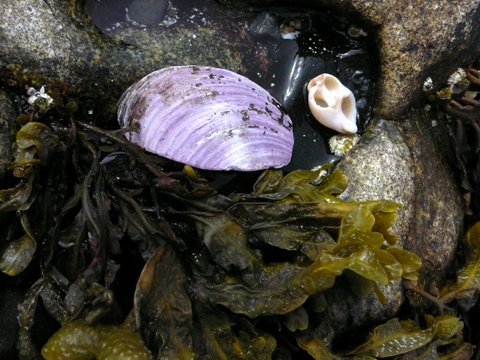
But surrounding the Light and the lighthouse, next to the small fragile cairns we build and the tide knocks down, there's the rock, the real St. Peter, about which we can do nothing but marvel. Upon this I will build my own church.


Saturday, July 7, 2012
Progress towards regress
I'd like to report a step backwards in our neighborhood. The little lane called Bay View has lost its asphalt. It's been cracking and eroding for a while now, and the other week cryptic marks were spray-painted on its surface and then some equipment - three specialized machines and one all-purpose guy - started to dig it up. Upon inquiry, the guy said they were not going to replace the asphalt. This, I said to myself, I have to see to believe.
Believe it. Bay View has always been one of my favorite walks, the striking ordinariness of a woods undeveloped - and now it's even better. Our neighbors who use and (presumably own) it have clearly decided that petroleum-based stuff is not cost-effective, where dirt and gravel are. Perhaps they even considered the deer who will now cross in comfort, the slugs who will no longer sacrifice themselves after a rain, the large increase in hunting grounds for birds, and the delight of at least one human in the new, softer, avenue of brown.
It's tempting to draw the analogy much further. The huge new LPG tank planned for Searsport would definitely go. Muscle cars, ditto. Coal burners re-fitted, plastic replaced by paper, diesel by electric, nylon by cotton, toothbrush by willow twig, hemp forever!. Hell, why stop at petroleum? Retreat from silicon and aluminium and uranium too.
Don't we wish. Much as I'd want the world to fall apart, regress to gravel, how can I do without my car and my computer and the ergonomics of home? I'm hooked: on power and comfort. The anachronism of Bay View seems such a tiny little thing, but it is a victory nevertheless. And doesn't the woodpile need replenishing?
Believe it. Bay View has always been one of my favorite walks, the striking ordinariness of a woods undeveloped - and now it's even better. Our neighbors who use and (presumably own) it have clearly decided that petroleum-based stuff is not cost-effective, where dirt and gravel are. Perhaps they even considered the deer who will now cross in comfort, the slugs who will no longer sacrifice themselves after a rain, the large increase in hunting grounds for birds, and the delight of at least one human in the new, softer, avenue of brown.
It's tempting to draw the analogy much further. The huge new LPG tank planned for Searsport would definitely go. Muscle cars, ditto. Coal burners re-fitted, plastic replaced by paper, diesel by electric, nylon by cotton, toothbrush by willow twig, hemp forever!. Hell, why stop at petroleum? Retreat from silicon and aluminium and uranium too.
Don't we wish. Much as I'd want the world to fall apart, regress to gravel, how can I do without my car and my computer and the ergonomics of home? I'm hooked: on power and comfort. The anachronism of Bay View seems such a tiny little thing, but it is a victory nevertheless. And doesn't the woodpile need replenishing?
Sunday, July 1, 2012
Gossip at the bird feeder
Quite a few years ago we hung a bird feeder from a tree branch in our backyard in Massachusetts. It quickly became a feeder for squirrels, who learned to jump from neighboring branches and demolish the contents in a couple of hours. I shouldn't be so prejudiced, I know, but arboreal rats deserve no help from humans, whereas the birdies, the cute little birdies....
Needless to say, the feeder experiment lasted but a week or two, in spite of new test branches, waving of arms, throwing of small rocks, etc. The feeder dangled forlornly for years, empty, a quiet reminder of the way of the world.
This spring our daughter came back from a stay in Deer Isle, Maine with tales to be envied. She and Max had placed a bird feeder just outside a window and could watch finches just inches away. Worse, she could go outside and sit perfectly still and chickadees would perch and eat seeds out of Bird Girl's hand. Inspired, we dusted off our feeder, slung the rusty chain over the bend of the downspout just outside our kitchen window, bought a huge bag of pumpkin seed, and waited.
The house finches, being used to us, came almost immediately. So did a lot of other species. and all was terrific for several days. I too would be a Bird Man. Then the level of seeds in the tube dropped alarmingly one day, and we discovered that a squirrel had cracked the case: it climbed up the rhododendron, jumped over to cling to the screen on the window, then leaped to the feeder. Some yelling ensued. Just one particularly agile and intelligent beast was hoped for. Unfortunately, the case was not isolated. It happened again, same squirrel, different squirrel, it didn't matter. We were beaten again. There's nothing quite so infuriating, by the way, as the sight of a splay-legged squirrel glaring at you from your screen, when you were hoping for the bluebird of happiness.
The feeder, dutifully filled and re-filled, went back down to the trees. Lots of birds came. So did squirrels. We greased the baffle - didn't work. They still climbed down the chain, got the feeder to rocking a bit, then artfully landed on the backswing. Feeder got moved. Now they jumped from other branches, or in a pre-Olympian try-out for the high jump, from the ground. Our one moment of pleasure came from a bird that seems to hate squirrels even more than we do. The usual feeding frenzy above and below was interrupted one day by a female turkey who spread her tail and ruffled her feathers and stretched out her long neck as she pursued the squirrels into the underbrush. We knew she was female because she was accompanied by five goblets, who clearly appreciated her efforts to clear the room for their own scavenging.
That seemed a good way to end the experiment for good.
On Friday, however, I reviewed the situation once more, with the aid of a ladder. The feeder now hangs from a very long chain, out of reach of other branches, high enough off the ground. A delightful two days have followed, full of sparrow and chickadee, of wren and finch and nuthatch and blue jay, of the female cardinal and her mate who appears to have alopecia, and of the grackle, ah the grackle, squirrel of the sky, whose iridescent blue hood shines beautifully in the sun but who is big and black and intimidates the smaller birds and gobbles down the seeds as fast as any squirrel. Oh well, we've got lots of seeds, and lots of glee, for the regular squirrels are reduced to scrounging around on the ground for leftovers. So far, that is.
Needless to say, the feeder experiment lasted but a week or two, in spite of new test branches, waving of arms, throwing of small rocks, etc. The feeder dangled forlornly for years, empty, a quiet reminder of the way of the world.
This spring our daughter came back from a stay in Deer Isle, Maine with tales to be envied. She and Max had placed a bird feeder just outside a window and could watch finches just inches away. Worse, she could go outside and sit perfectly still and chickadees would perch and eat seeds out of Bird Girl's hand. Inspired, we dusted off our feeder, slung the rusty chain over the bend of the downspout just outside our kitchen window, bought a huge bag of pumpkin seed, and waited.
The house finches, being used to us, came almost immediately. So did a lot of other species. and all was terrific for several days. I too would be a Bird Man. Then the level of seeds in the tube dropped alarmingly one day, and we discovered that a squirrel had cracked the case: it climbed up the rhododendron, jumped over to cling to the screen on the window, then leaped to the feeder. Some yelling ensued. Just one particularly agile and intelligent beast was hoped for. Unfortunately, the case was not isolated. It happened again, same squirrel, different squirrel, it didn't matter. We were beaten again. There's nothing quite so infuriating, by the way, as the sight of a splay-legged squirrel glaring at you from your screen, when you were hoping for the bluebird of happiness.
The feeder, dutifully filled and re-filled, went back down to the trees. Lots of birds came. So did squirrels. We greased the baffle - didn't work. They still climbed down the chain, got the feeder to rocking a bit, then artfully landed on the backswing. Feeder got moved. Now they jumped from other branches, or in a pre-Olympian try-out for the high jump, from the ground. Our one moment of pleasure came from a bird that seems to hate squirrels even more than we do. The usual feeding frenzy above and below was interrupted one day by a female turkey who spread her tail and ruffled her feathers and stretched out her long neck as she pursued the squirrels into the underbrush. We knew she was female because she was accompanied by five goblets, who clearly appreciated her efforts to clear the room for their own scavenging.
That seemed a good way to end the experiment for good.
On Friday, however, I reviewed the situation once more, with the aid of a ladder. The feeder now hangs from a very long chain, out of reach of other branches, high enough off the ground. A delightful two days have followed, full of sparrow and chickadee, of wren and finch and nuthatch and blue jay, of the female cardinal and her mate who appears to have alopecia, and of the grackle, ah the grackle, squirrel of the sky, whose iridescent blue hood shines beautifully in the sun but who is big and black and intimidates the smaller birds and gobbles down the seeds as fast as any squirrel. Oh well, we've got lots of seeds, and lots of glee, for the regular squirrels are reduced to scrounging around on the ground for leftovers. So far, that is.
Subscribe to:
Posts (Atom)