About Me

My photo
Retired publishing executive ecstatic with the idea of spending most of his time on the coast of Maine

Friday, September 11, 2015

Allagash Wilderness Waterway: 8/31/15 - 9/4/15, Day 4

Day 4 – Hosea B to campsite McKeen Brook

     A chattering red squirrel provided a wake-up call and we were up at 6:00, and repeated the same wonderful breakfast. On the river at 7:45.
     Just after breakfast I happened to look upstream and saw a moose crossing the river. She was a few hundred yards away, but still a wonderful sight. 


                                        Moose at Hosea B campsite
    
     Steady paddling for several hours ensued. We’ve now figured out our best canoe positions, that is, I figured out my canoe position, having performed somewhat poorly in the single-person boat and at the stern of the double. The bow it was for me. No doubt with more practice, and general acclimation to the confounding confusion of left vs right, paddle vs direction movements, I would have figured it out, say in a week or two. After all the 26-year-olds, male and female respectively, did brilliantly in those positions, considering they had never been river-canoeing before.


                                          Lunch at Michaud Farm 
   
      We saw three canoes up ahead, also 6 guys, and the Dance of the Six-Packs started in earnest. We stopped at the Michaud Farm ranger station for lunch and discovered on check-in that the pack ahead of us, which was leaving the station as we arrived, was from North Carolina and which, judging by the day of their first put-in, was very speedy. The pack behind us of course arrived at the station just as we were finishing lunch. One of the men, quite old, walked up to where we were sitting in the shade (it was a perfect day, by the way, just hot in the sun) and clearly wanted to tell their story. After the obligatory questions (where are you from, etc – they were from Rochester, NY), he said they had started out from Churchill Dam several days before, and in the difficult rapids just below the dam, crashed one of the canoes. It took hours to retrieve it in the fast water, and they had to go back for repairs (lots of duct tape), and were a day late on their schedule, thus accounting, perhaps, for their co-habitation at Croque Brook. They may have been too tired to get to the next site 6 miles away. We generated some sympathy.
     After lunch, we paddled an hour to Allagash Falls through a beautiful stretch of what we guessed were silver maples. The sound of their leaves in the breeze rivaled the sound of the stream. The falls are not passable and the portage was a third of a mile. We each made three round-trips and I was beat. But the falls viewed from downstream were amazing: a forty-foot drop over several hundred yards resulting in a thick, twisting muscular braid of white water.


                                         Allagash Falls from land


                                       Allagash Falls from the water

     We thought we had a deal with the Rochester six-pack that they would stay at the first site past the falls and we would stay at the second, McKeen Brook. But of course, who showed up about an hour after we unloaded at McKeen Brook? We couldn’t believe they would be so rude as to kick us out twice. But E was brilliant. She went down to the water as they were discussing what to do (they said they missed the first site, and actually we didn’t see it either), and said the other cell at this site is really small and really close to ours, do you really want to stay here, all in the nicest possible way. It worked. They moved on; we rejoiced.


                                          McKeen Brook campsite
    
     As I said, I was beat from the portage, and E/M let me have a magnificent hour in the hammock when they cooked dinner (still and always guilt-free with hot dogs, beans, and carrots).


                                       Serving dinner at McKeen Brook 
   
          We stayed up very late night staring at the fire – 8:30 to bed!

          Distance: about 20 miles


          Wildlife: lots of eagles, geese flying north (!), plus beaver

          Next: day 5

Wednesday, September 9, 2015

Allagash Wilderness Waterway: 8/31/15 - 9/5/15, Day 3

Day 3 – Cunliffe Island to campsite Hosea B

     We were up and at ‘em by 6:30, ate breakfast of juice, coffee, bacon, eggs, bread grilled on the open fire, with butter and jam, and were on the river by 8:30.
     We paddled about 10 miles to the southern end of Round Pond for lunch at Back Channel campsite. The map marked a long stretch of rapids but they didn’t seem as bad as the previous day’s, or maybe we’re getting better.


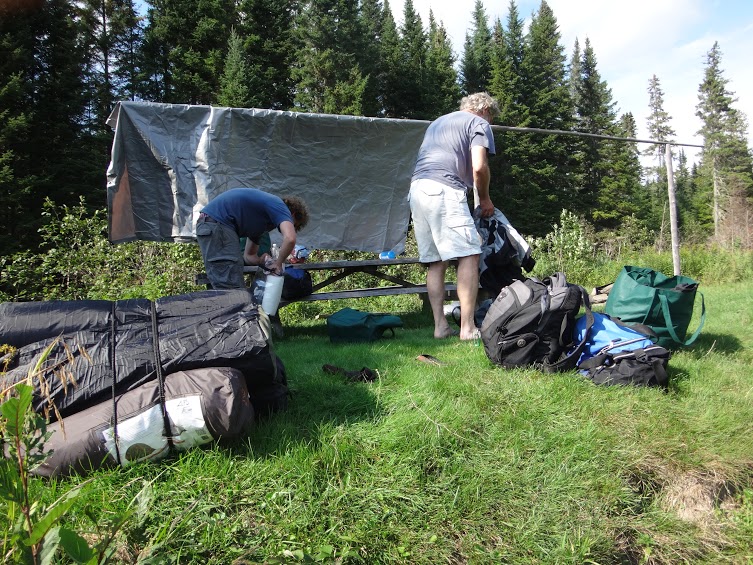
                                           Typical AWW campsite    
     
     Just before Round Pond was the second of only two bridges over the river, looking very out of place, especially when we saw a log truck roll over in a cloud of dust after we had passed underneath.
     After lunch, we saw the same couple approaching us at Back Channel (and that was the last we saw of them). After some discussion about the weather (there was a little thunder and dark clouds moving quickly from the west), we headed out into Round Pond for what was intended to be a fast push to the next campsites if weather forced us in. Unfortunately, the wind picked up mightily as we got half-way across and M nearly lost control, unable to turn into the wind, and we had to paddle hard to catch him.


                                      Storm clouds over Round Pond    
    
     The storm passed us by, with just a bit of refreshing shower (it was a hot day), the only rain on the trip, and we decided to go on farther. We met the Round Pond ranger who was about to police his campsites, and he offered to guide us through the rapids after the pond. The smell of his outboard-powered canoe was a little disconcerting, but we were grateful for the help and hung up only once.


                                    View from Croque Brook campsite 
   
     After another couple of miles we stopped at Croque Brook campsite for the night, or so we thought. Twenty minutes later, after we were partly set up, a party of three canoes and six older men came up and stopped at the same site. It’s still not entirely clear (although see Day 4 for some speculation) why they choose to be right next to us (although it was a two-cell site) on a long river, with almost no traffic, with a plethora of sites on offer. E/M wanted to pack up and leave. I was advocating staying, but then walked a little way toward the other cell and heard how loud the men were, even across perhaps a hundred yards of space full of bushes, and realized that we would have to share one privy, obviously especially trying for E, and voted for going on. As we left, someone in the group did apologize for kicking us out.


                                          Re-packing at Croque Brook
     
     We were very glad we moved: Croque Brook was probably the least attractive site we saw, being open and tree-less (no hammocking!) and the extra six miles was well worth it, for Hosea B campsite was lovely and simple, nicely elevated, lots of trees, with a small cold brook nearby to replenish our water supply, the river calm and deep and by evening time, glassy-smooth.
     That was one of the joys of the trip: the multitude of faces the river showed, from gentle riffles, to slow deep currents, to fairly serious rapids and every complexion in-between, not to mention the endless anticipation of what was waiting around the next bend.


                                       Evening at Hosea B campsite

     Besides seeing the one log truck on the bridge, hearing another on an access road near the end of the trip, and some rumblings of machinery in the distance for an hour or two, the only evidence of logging was a clear-cut hill in the distance, with a weird stand of big trees left at the crown.
     Speaking of annoyances, I should say here that our trip was remarkable bug-free: a few no-see-ums, a few mosquitoes, a few biting flies in the canoes that took advantage of our attention to nothing but the water ahead. Even though it turned out to be quite a warm and muggy night – hardly needed a sleeping bag – the bugs were not a bother.
     My little tent was a joy. Just (about) seven feet long and four feet wide, it was composed mainly of a fine mesh that allowed views up to the starry sky, on one side woods, on the other river. And I could hear everything, from the ticking of tree bits falling, unidentified sounds in the woods, footfalls of bear or toad perhaps, creepy, crawling things headed over, under, or around. For someone like me not used to camping, sleeping in tents is intense, a combination of fear and joy, relaxation and worry, resulting in an insomnia that was wonderful to bear.


                                                   Hosea B campsite
\    
     I was very glad we had no rain, for the tent’s rain fly looked to be a claustrophobic cocoon.
     Dinner, still defiantly guilt-free: steak on the grill, potatoes and butter, carrots. In bed by 8:00. But right after going to bed, we heard several loud, deep splashes in the river, like someone throwing very big rocks. Our best guess was that they were beaver slapping their tails (were they annoyed at us?) especially since the next morning just a few minutes after putting in, we saw a beaver swimming near a lodge.
     Distance: about 20 miles

     Wildlife: great blue herons, lots of eagles

Next: day 4

Monday, September 7, 2015

Allagash Wilderness Waterway Trip – 8/31/15 – 9/4/15, Days 1 and 2

Before-thoughts of the Allagash

     Excitement and nerves characterized the days of planning. None of us (daughter E, her boyfriend M, and I) have ever done anything like this before: four days and three nights on a remote river in northern Maine, without roads, stores, electricity, motors, phone service. We’ll carry everything we need in canoes, and of canoeing we have some lake experience but not river, and certainly not of fast water. The Waterway is 92 miles long; we will travel about two-thirds of it, skipping the big lakes at the southern end and ending nearly in Canada.
     Nerves: How often will we capsize? Will it rain? Will the insects be vicious? Can we accomplish the portages? Will our food last?
     Excitement: Will the beauty be overwhelming? Will we see moose? How wonderful will it be to glide on a river, sleep under the stars, sit around a campfire?
     This and following posts will mostly be an account of what happened. The photos were taken by my daughter. I’ll save editorializing (which is impossible for this writer to avoid) for after-thoughts at the end.

Day 1 – Owls Head/Deer Isle to Millinocket

     This was a car travel day. I left Owls Head about 2:00, stopped in Rockland for groceries, and arrived in Millinocket about 6:00. E/M arrived from Deer Isle shortly thereafter and we checked in for the night at the Pamola Motor Lodge. We had dinner at the nice little Appalachian Trail CafĂ©. Millinocket, still in the throes of the closing of paper mills, has not much else to offer.

Day 2 – Millinocket, to put-in at lower end of Umsaskis Lake, to Cunliffe Island campsite

     We drove both cars to Katahdin Outfitters just outside Millinocket and left them there. All of our gear was loaded into a truck and we were driven to the put-in at Umsaskis Thoroughfare Bridge by Doug, the father of the owner of KO. He is a native Mainer and interesting mix of conservative and liberal. We talked about local politics and economics, including the controversial proposals for a national park in the area, the wildlife in the area, adventures in Maine. Most of the roads we took were rough logging roads, and we met a number of transport trucks, empty, having delivered full loads to Canada (!). Oddly enough, Maine has very few sawmills, just as it has very few lobster processing plants. It’s still largely a place for harvesting natural resources. The real wealth is elsewhere. Even the timber companies, some of whom are good stewards of resource and roads, and some of whom are not, are on shaky financial grounds these days.


                                 Umsaskis Bridge from downstream 
   
     We arrived at the Umsaskis Bridge about 10:00, unloaded the truck, and were left with the strong feeling of being very alone. Doug, don’t leave quite yet! But activity helped, figuring out the best way to load the canoes and getting on the water and into Long Lake. Bliss descended as soon as we started paddling. It was a clear, slightly breezy day, and it was good to start with an easy paddle, about four miles to the north end of the lake, before the river turned narrow and the water fast. The map showed no rapids here, but our inexperience said there certainly appeared to be. Several mishaps occurred, all relatively minor, involving shoals and hang-ups, but the river was surprisingly warm and generally shallow (we discovered afterwards that the cubic flow per second was around 800 cubic feet per second for our trip, well below the “comfortable” level of 1,000), and it was easy to get out and push the canoes over sandbars and off rocks.


                                               On the river at last


                                               Lunch on a sandbar

     We ate lunch (sandwiches, fruit, candy) on a sandbar and then had a brief paddle through Harvey Pond to Long Lake Dam, just the remnants of a dam, that is, and here the rapids were strong enough, and the left-over dam bits protruding enough, that a portage was recommended, which we took. It was just a short one, easily managed. We thought about staying at the campsite there, since it was so pretty, but the rapids were quite loud, and we saw another canoe approaching, and we decided to try the next site, Cunliffe Island, and were very happy we did.
     Approaching the island, we saw a cow moose standing in the right channel, eating. Very slowly we drifted past, watching quietly, then parked at the campsite to unload and set up. In the middle of setting up, we heard splashing and ran down to the water’s edge to see our cow slowly crossing the river to the left channel, then meandering down the opposite bank, stopping to eat river grass. All in all, a 20-minute viewing of this great animal, who, by the way, saw us just a few yards away and didn’t seem to give a damn.


                                                 Meandering moose
    
     The lakes we paddled through were calm and beautiful and serene, but the river is what really makes you feel that this is a wild place.
     One of my hammock anchors on the river edge was a huge white pine close to 100 feet high and three feet thick. It was complete bliss to listen to the sound of water moving over stones, to look up at sky through the branches of trees.


                                             Cunliffe Island campsite 
   
     Once on the water, the only people we saw all day were those two people following us at Long Pond Dam, where they must have stayed the night. A helicopter did fly over (twice) and a small plane (once) but the intrusions were quickly gone.
     For our guilt-free (free of vegetables, basically) dinner, we ate sausages and bread grilled over the open fire, plus beans and Rice-a-Roni, and were in bed by 8:00.
     Distance paddled: about 8 miles.

     Wildlife seen: moose, loons, kingfishers, mergansers

Next: day 3

Sunday, September 6, 2015

Osprey

Last evening I had the great pleasure of a lengthy visit from an osprey, who sat in a tree on the shore for some 15 minutes, quite still except for head and neck. I watched through binoculars until my arms were tired. In its usual position high offshore, one can't see the power of its hooked beak, strong wings, broad chest. It didn't even leave when the @#$%^ lawn mower started up close by.

In 20 years I have never seen an osprey perch in one of our trees. Perhaps its dinner was schooling close to shore and it was waiting to be served. More likely, it knew that I had just come back from a canoe trip on the Allagash Wilderness Waterway (report coming over the next few days) and wanted to let me know that this place is pretty special too.